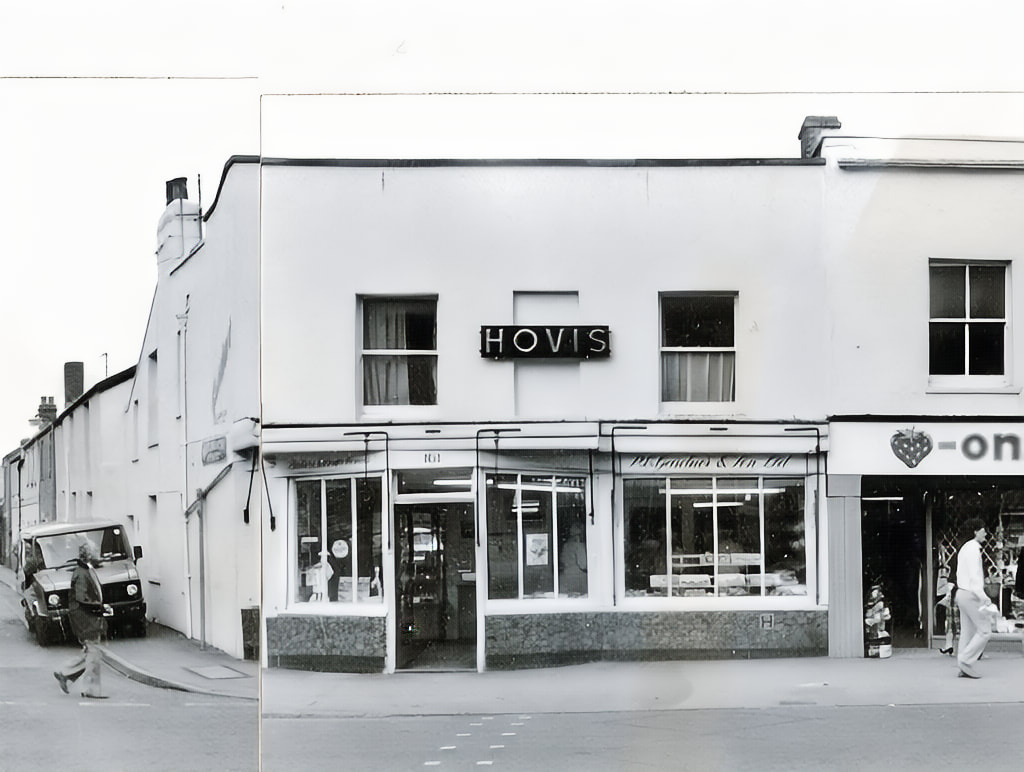
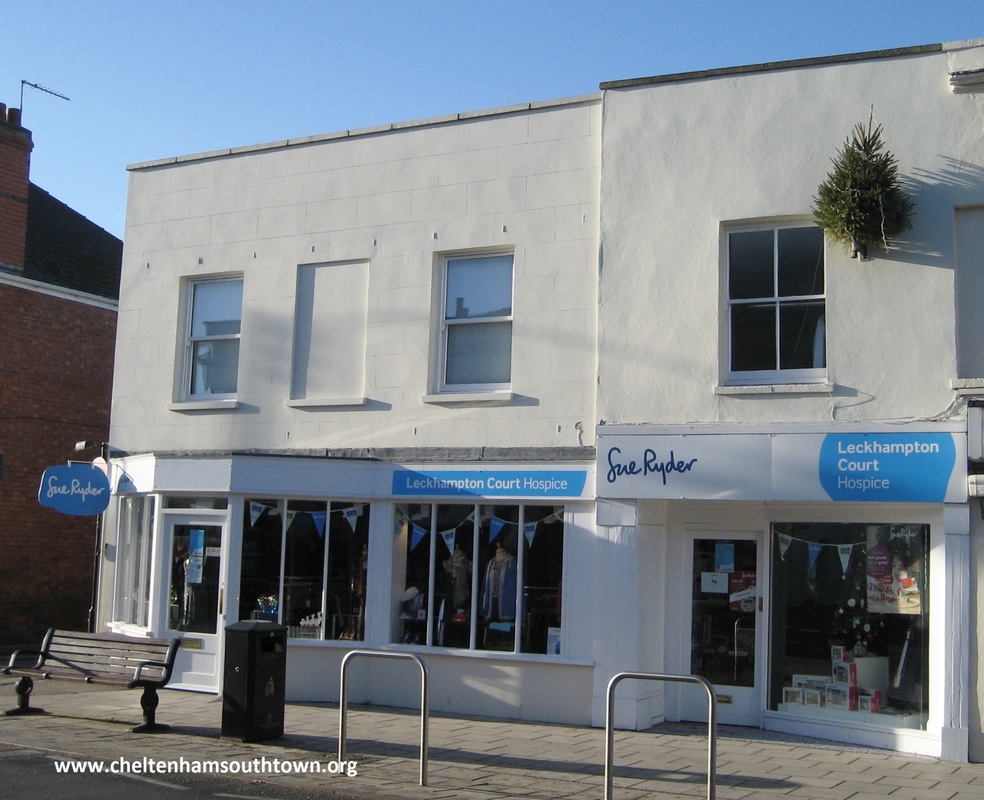
161 Bath Road (formerly 5, Adelaide Buildings)
This very small shop was the tobacconist’s business of Francis Rowland, who was born in Tewkesbury in about 1848. His parents, Benjamin and Annie Rowland ran the butchers at 163 Bath Road. Francis was a talented musician and by the age of 34 was calling himself a Professor of Music, which implies that he gave lessons. He lived at these premises with his wife Ellen and their two daughters until the beginning of the 20th century.
There followed several occupants including Mr W.J. Nickolls, the boot-maker Robert Welch, whose son lived a few doors away, and two grocers, Mr J.H. Parker and Mr William Albert Castle. Mr Castle’s family ran the larger grocery shop two doors away at 163 Bath Road.
Since this small shop had only a sash window, to create some ventilation in hot weather Mr Castle would prop the window open with a packet of sultanas. It seems likely that some of these would have disappeared during the course of a summer, taken by mischievous youngsters! In 1927 Mr Castle sold this shop to his neighbour Richard Cripps to enable him to enlarge his bread shop.
161 Bath Road (formerly 6, Adelaide Buildings)
This corner property was a bread shop for around 150 years and a bakery for most of that time. It belonged to the Isher family for at least 45 of those years.
William Isher lived here with his wife Esther, his sons Charles, Henry and Albert and his daughter Selina. Both Charles and Henry followed their father and became bakers, whilst Albert earned his living as a blacksmith and Selina became a dressmaker.
William died in April 1875, after which Henry and Selina continued to live here unmarried , whereas Charles lived with his wife and family at Pilley, in Leckhampton. Their mother Esther died in May 1892, at the great age of 96, and when Henry died just five years later Selina inherited his estate. This included the shop premises at 5 and 6 Adelaide Buildings and some property in St James’s Place, now part of Painswick Road. When Selina died, in around 1903, her niece Gertrude (the daughter of Charles) inherited this Bath Road bakery which she kept until about 1908. The shop was then sold to Mr J.C. Williams who was here until 1922, when he sold it to Mr Richard Cripps for the astonishingly low cost of twenty five pounds!
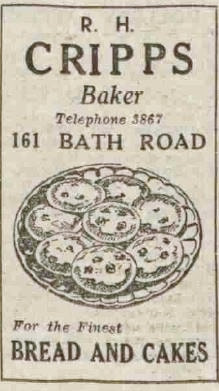
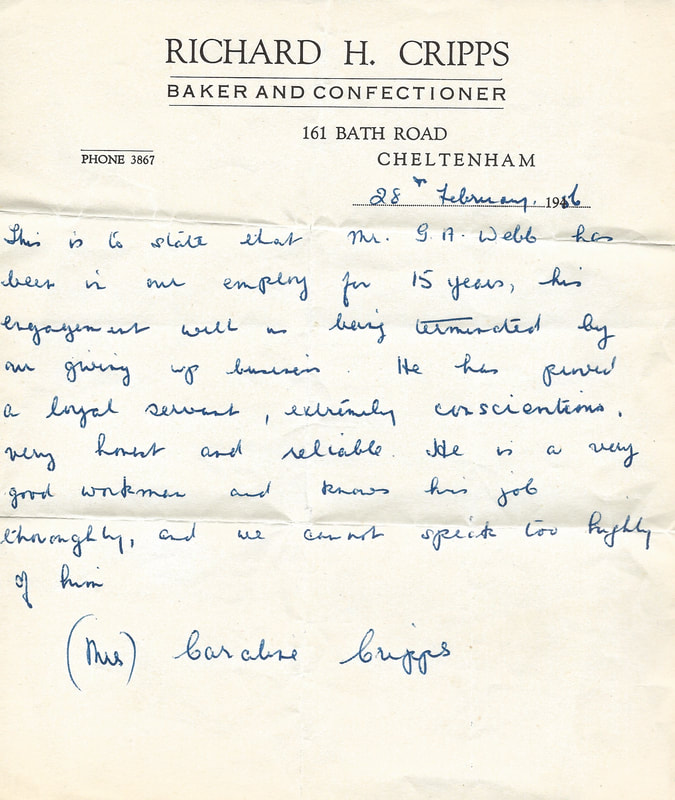
Richard Cripps completed his apprenticeship with Bloodworth’s Bakery in Albion Street. The family lived in Francis Street and when his youngest daughter Freda was six years old they all moved to the bakery in Bath Road. Freda’s older sisters Iris, May and Eveline helped in the shop, whilst her brothers Sid and Dick worked in the bakery. Sid would deliver bread in the van, except when he used a carrier bike for more local deliveries.
In about 1927 Mr Cripps bought the small shop next door belonging to Mr Castle in order to enlarge his shop and had the dividing wall knocked through on a Sunday to avoid disrupting the business. To enable him to see into the shop from the back room in case customers required attention (and to prevent pilfering) he had a mirror installed. Several people were caught helping themselves in this way! The mirror also enabled customers to see into the living area where they would sometimes see either a green or grey parrot perched on someone’s shoulder.
The baker’s day started in the middle of the night. Although the shop didn’t actually open until 7 am, those workers needing nourishment before that time called at the side door, where Freda would be selling drippers. Cripps bakery was also famous locally for their jam doughnuts. Fancy cakes were not as popular as good old fashioned scones and currant buns.
Bread was baked in a variety of sizes, the most popular being the cottage loaf, especially if it was popped back in the oven for a few minutes to crust up. They also made wholemeal loaves using Allinsons flour and brown loaves from Hercules flour. The bakery supplied other shops in the area, sometimes making deliveries as late as 8 pm. The shop closed at 6 pm most evenings but stayed open until 7 pm on Fridays and 8 pm on Saturdays. Most days the bread sold out but any that was left over was sent to the Nazareth House orphanage, which was located opposite Cheltenham College, where Century Court stands today.
Easter was an exceptionally busy time and the bakers would work all night to get the hot cross buns into the shop for opening time. Freda’s job was to put the X on the buns, which sold for one penny, or one shilling for a baker’s dozen (13).